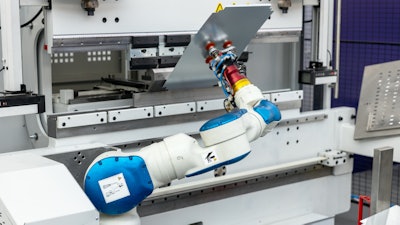
Industrial service robots are improving productivity and efficiency in manufacturing, logistics, and automated warehouses across multiple industries. While these robots boast vast networks of sensors, processors, actuators, and communication systems working together to achieve autonomous operation, a critical yet often overlooked component is connector solutions that enable them to function in industrial environments.
TE Connectivity’s interconnect solutions address the reliability challenges manufacturers face when building industrial service robots as off-the-shelf connectors typically fail to meet requirements for miniaturization, durability and performance.
Enabling autonomous movement and situational awareness
Navigation and safety systems in service robots use arrays of sensors, such as LiDAR, ultrasonic detectors, vision cameras, and inertial measurement units, to achieve holistic environmental awareness.
A key requirement is for each sensor to continuously generate data streams that are transmitted without loss or corruption to the CPU for real-time analysis and decision-making.
 Figure 1: The ERNI MicroCon series.TE Connectivity
The miniaturized 0.8 mm pitch spacing delivers space savings compared to 1.27 mm alternatives, which enables robot designers to integrate additional sensors into limited spaces.
The MicroCon’s dual-beam female contact design provides exceptional reliability for sensor connections, with a 1.9 mm wipe length for consistent electrical connectivity under continuous vibration. Additionally, the wider contact surface in the dual-beam design helps minimize variations in contact resistance that can introduce noise to sensitive sensor signals.
The connectors support data transmission rates of up to 3 Gbit/s, suitable for high-resolution camera systems and advanced LiDAR units that generate massive data volumes. The operating temperature range is from -55 to +125°C, ensuring reliable performance whether the robot operates in sub-zero temperature environments or near industrial heat sources.
Safety systems in service robots also need fail-safe connectivity to maintain signal integrity under adverse operating conditions. The MicroCon’s blind-mate pre-centering capability with ±0.7 mm misalignment tolerance is especially useful in modular robot designs where sensor modules require frequent replacement for maintenance or reconfiguration.
Central control units: supporting precise command and coordination
In the control units of industrial service robots, power distribution efficiency and high-density signal routing capabilities are critical. These systems are responsible for coordinating motor controllers, processing sensor inputs, managing communication interfaces, and maintaining real-time control loops, using either battery power or industrial power supplies.
Entrelec DBL Power Distribution Blocks can be integrated to optimize power management in control units. These blocks utilize a 3-in-1 configuration system that consolidates a single-pole splitter, multi-pole splitter and grouping configurations into a single product family. With current ratings ranging from 80 A to 550 A, DBL blocks can meet the power needs of industrial service robots, from low-power sensor circuits to high-current motor drives.
Moreover, a 1500 VDC capability aligns with the latest high-voltage battery systems/industrial power supplies, while a 100 kA short-circuit rating offers exceptional safety margins to protect sensitive electronics from system faults.
 Figure 2: AMPMODU family of connectors.TE Connectivity
The AMPMODU connectors are available with pitches ranging from 1mm to 3.96 mm. High-speed processor interconnects can benefit from the 1mm centerline option, offering significant space savings compared to 2.54 mm connectors, while power and low-speed control signals can use larger pitches for easier assembly and higher current capacity. This flexibility allows control unit designers to optimize board layouts for both electrical performance and manufacturing efficiency.
Delivering high-speed, durable connections
 Figure 3: TE Connectivity’s Industrial Mini I/O connectors.TE Connectivity
With data rates ranging from 10 Mbps to 10 Gbps, the Mini I/O system can be used with both legacy fieldbus protocols and newer Time-Sensitive Networking (TSN) implementations. Power over Ethernet (PoE) capability can also simplify wiring architectures, further reducing the weight of robots. Moreover, Mini I/O connectors feature 360-degree metal shielding to protect against electromagnetic interference in industrial environments, where variable-frequency drives, welding equipment, and other high-power systems can generate electrical noise that could otherwise corrupt data transmissions.
Mini I/O connectors feature a hermaphroditic contact layout with spring action on both the plug and receptacle sides, ensuring consistent performance throughout the connector’s 5,000 to 10,000 mating cycles. This durability can be valuable in robots that dock repeatedly for charging or data transfer, as RJ45 connectors typically fail after hundreds of cycles. The 98N cable pull force rating prevents accidental disconnections during robot movement, while the compact form factor enables multiple network interfaces within limited panel space.
 Figure 4: The Dynamic Mini.TE Connectivity
For internal communication between distributed control modules, TE Connectivity’s Dynamic family covers 3 A signal connections up to 100 A power links. Operating specifications from -55 to 105°C with vibration and shock resistance provide reliable operation throughout the robot's operational lifetime.
Future-ready connectivity for evolving robotics trends
As service robots achieve full autonomy with enhanced capabilities and deeper integration with IIoT systems, connectivity will only become more demanding. For example, integrating 5G communication capabilities into industrial robots will require connector solutions that support high-frequency signals and antenna connections for wireless operation. Emerging technologies like Single-Pair Ethernet will enhance robot networking by delivering high-speed communications over simplified cabling. TE Connectivity is positioned to support these emerging standards while maintaining backward compatibility with existing protocols.
Edge computing implementations that place artificial intelligence processing directly within robots demand exceptional signal integrity for high-speed processor interconnects. The AMPMODU and MicroCon systems' proven performance at multi-gigabit data rates ensures readiness for these computational advances. As robots become more intelligent and autonomous, the reliability and performance of their interconnection infrastructure become even more critical to overall system functionality.
Industrial service robots are among the most demanding applications for durable connector technology, combining requirements for miniaturization, durability, signal integrity, and power handling that push traditional solutions beyond their limits. TE Connectivity’s comprehensive portfolio of specialized connectors, including ERNI MicroCon, Entrelec DBL blocks, and more, provides reliable connections across a broad range of robotic applications across multiple industries.
 Rich Miron is the Senior Technical Content Developer at DigiKey.DigiKey
DigiKey is recognized as the global leader and continuous innovator in the cutting-edge commerce distribution of electronic components and automation products worldwide, providing more than 17 million components from over 3,000 quality name-brand manufacturers.