BEP Surface Technologies, an electroplating and surface finishing specialist, has embarked on a nearly $805,000 project to transform a 70-year-old Churchill TWR roll grinder into a state-of-the-art flagship of UK precision engineering.
In partnership with Siemens and Made Smarter, the grinder is undergoing a complete mechanical and electrical overhaul to deliver tolerances as fine as 0.001 mm.
BEP expects the two-year refurbishment project, now 30% complete, to significantly expand its capacity and capability, enabling the company to produce ultra-precise finishes for high-growth sectors such as electric vehicle batteries and carbon fiber manufacturing, while reshoring critical capability to the UK.
Machine 22, as it is known at BEP, was built in the 1950s. The company acquired the machine a few years ago as part of its investment and growth strategy from a former supplier in the paper industry.
The upgrade looks to equip Machine 22 with a Siemens SINUMERIK One CNC control, servo motors and a SINAMICS S120 drive system, enabling BEP engineers to grind and camber grind rollers to tolerances five times finer than before. The integration of digital controls will also allow BEP to document and report precision machining processes, ensuring full traceability and quality assurance for customers.
Machine 22 offers a swing diameter of 1,800 mm, a between-centers capacity of 8,000 mm and the ability to carry more than 20 metric tons.
The integration work is being carried out by Machine Code Engineering, which will source the Siemens system directly, install and program it into the machine and complete all associated electrical work. Machine Code will also provide five days of operator training to ensure BEP’s team can fully utilize the upgraded system.
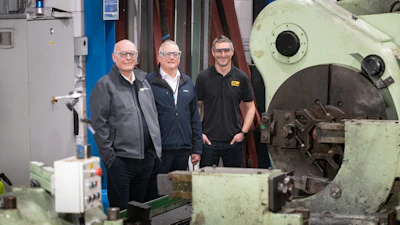
The project is being led by BEP Project Manager Jamie Needham, who began his career with the company as an apprentice at the age of 18. Now 25, Needham has already overseen major investment programs, including the pit refurbishment of BEP’s electroplating department.
"Our existing grinders are capable of 0.005 mm tolerances, but that’s not enough for many of the enquiries we receive,” Needham said. "Machine 22 will allow us to say yes to work we’ve had to turn away in the past."
This project builds on BEP’s recent $873,000 refurbishment of its electroplating department, marking another significant reinvestment in the business. With labor, technology and training included, the total value of the Machine 22 upgrade exceeds $806,000.
"It is a flagship project that shows how we can use digital technology to push the boundaries of precision engineering," BEP Surface Technologies Managing Director Andrew McClusky said. "By achieving tighter tolerances and higher quality standards, we are enhancing our capabilities, securing new business and ultimately helping our customers innovate and compete globally.”
BEP explained that the investment also addresses a market gap. The company noted that UK companies in fast-growing sectors, such as EV batteries and composites, are sending rollers to Europe because they cannot achieve the required tolerances domestically.
By bringing this capability to Manchester, BEP expects to reduce costs, shorten lead times, cut carbon emissions and strengthen UK supply chains. Customers include TetraPak and Syensqo, who rely on ultra-precise rollers for packaging and carbon fiber production.