As the electric vehicle market races forward, Rivian is grappling with a challenge familiar to most automotive companies: how to scale quickly without suffocating innovation. A recent demonstration from Rivian and Stratasys revealed how additive manufacturing may help rewrite some of the industry’s most entrenched rules.
Jonathan Dankenbring, senior manager of prototype manufacturing at Rivian, framed the company’s outlook bluntly. Rivian is not merely designing new vehicles; it is trying to reinvent the process by which vehicles are conceived, tested and produced. For a young automaker trying to grow fast, that ambition comes with substantial risk.
“We need ways to iterate quickly,” Dankenbring explained, “without getting locked into a process that’s expensive, slow and irreversible.” Traditional automotive playbooks—heavy tooling, limited iteration, multi-month lead times—don’t allow for that. When Rivian prototypes a new part or system, it can’t afford to wait for tooling before confirming whether an idea works. Nor can it afford to make costly bets too early in the design cycle.
This is where Stratasys sees an opportunity. Fadi Abro, senior global director of automotive and mobility at Stratasys, emphasized that 3D printing has matured beyond its early role as a playground for experimental prototypes. Stratasys’ current aim is not simply to shorten prototyping, but to collapse the gap between prototyping and production altogether.
According to Abro, the industry often evaluates additive manufacturing using the wrong metric, being per-part cost. “The value isn’t just cheaper parts,” he argued. “It’s eliminating tooling, accelerating testing, reducing inventory and enabling faster decisions.” In other words, additive is less about replacing a molded bracket with a printed bracket, and more about restructuring the development process that leads to that bracket.
Rivian, like many modern EV companies, thrives on speed of iteration. That speed is not merely an advantage; it is a requirement for survival, especially as Rivian navigates shifting markets, rapid technology cycles and evolving consumer expectations. Dankenbring described an engineering culture that encourages challenging conventions and redesigning aggressively. In that environment, the ability to “fail fast without costing a fortune” becomes a strategic asset rather than a liability.
But for Rivian, experimentation isn't enough—scalability matters. While many 3D-printed components have historically been relegated to prototypes, Rivian is interested in a path where early designs can transition into end-use parts without radical redesign or retooling. Dankenbring stressed that any technology Rivian adopts must support that continuity. The company doesn’t want a prototyping workflow on one side and a manufacturing workflow on the other, with a massive gulf in between. “Design once, refine continually and scale intelligently,” is how he summarized Rivian’s ideal.
 Various 3D-printed parts used by Rivian.Devon Verbsky
Abro responded to this challenge by surfacing a broader industry shift. Additive manufacturing companies, including Stratasys, are increasingly focused on production-grade materials, systems and certification frameworks that can handle the rigor of automotive use cases. He argued that the barrier to adoption is no longer whether additives can physically produce end-use parts, but whether manufacturers are willing to abandon decades of entrenched assumptions around tooling, batch production and supply chain optimization.
A philosophical divide is also at play. Traditional manufacturing economics favors predictability; additive manufacturing favors adaptability. Rivian’s speed-centric engineering culture may make it well positioned to benefit from that shift, particularly as it seeks to challenge industry incumbents who built their systems around long-cycle manufacturing predictability.
Still, Dankenbring acknowledged that Rivian must make decisions grounded in the realities of cost, quality and reliability. For additive manufacturing to become a viable long-term strategy, it must scale—not just technically, but economically. Rivian’s interest lies in solutions where early exploration doesn’t lead to sunk investments that become obstacles later.
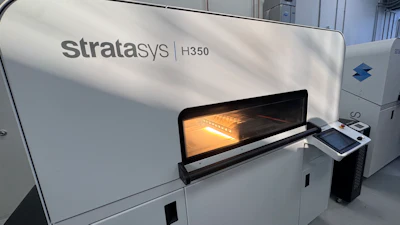
 Rivian's small-scale 3D printing station.Devon Verbsky
The showcase between Rivian and Stratasys hinted at the possibility of a new model for automotive development—one in which innovation is not constrained by tooling cycles, where risk is affordable and where agility is engineered into the product from day one. It also highlighted a shared belief that the next wave of manufacturing transformation won’t come from replacing existing processes one-for-one, but from rethinking the underlying logic of how products are designed and built.
Both companies appear to agree: the future of automotive manufacturing will be shaped not just by electrification, but by the tools and techniques that make fast, flexible and scalable innovation possible. Additive manufacturing, if deployed strategically, may be one of the technologies capable of delivering that shift.