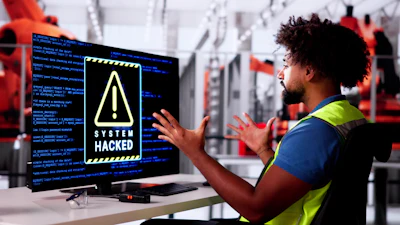
In May 2026, a ransomware attack against electronics manufacturer Foxconn disrupted production across its North American operations, including its Mount Pleasant, Wisconsin, and Houston manufacturing campuses.
Attackers claimed to have stolen eight terabytes of data. Headlines like these have become an unfortunate reality for manufacturers. According to Industry 4.0 expert Walker Reynolds, the biggest cybersecurity challenge most plants face every day is securely connecting people to production equipment.
The lesson for manufacturers seems obvious. Invest more in cybersecurity. Reynolds says that's not the conversation manufacturers are having every day.
"Everybody is complaining about remote access," said Reynolds, founder of 4.0 Solutions. “On one side of the argument, it's security and compliance. On the other side, it's, 'I can't work. I can't access the equipment.'"
That conflict has become one of manufacturing's biggest operational bottlenecks.
A controls engineer needs to troubleshoot a machine. An OEM needs to update a programmable logic controller (PLC). A systems integrator needs to connect to an HMI. The work itself might take 20 minutes.
Getting permission to securely access the machine can take hours or days. Meanwhile, production waits.
As Reynolds bluntly puts it, "Production is king." The irony is that the machines causing the debate usually aren't the problem.
Across manufacturing, plants continue to rely on production assets that are 15, 20 or even 30 years old. Those PLCs, CNC machines and industrial controllers continue producing quality products every day. Replacing them simply because cybersecurity has evolved isn't financially realistic.
The challenge is connecting modern IT environments to legacy OT assets without creating new vulnerabilities.
One recent food and beverage manufacturer illustrates the dilemma.
Across 11 North American facilities, nearly 400 serial and Ethernet-connected devices averaged 18 years in age. Production was meeting its goals, but nearly all of the operational data remained trapped inside aging PLCs and historians. Engineers spent much of their time maintaining legacy serial connections, while production data was literally transferred by USB drives because it couldn't move securely into manufacturing execution systems (MES) and analytics systems.
The manufacturer didn't need new machines. It needed a better way to connect the ones it already owned.
Security by Removing Trust
If Reynolds describes the operational problem, Chase Cunningham explains why it exists.
Cunningham is a former U.S. Navy cryptologist, NSA veteran, and creator of Forrester's Zero Trust eXtended framework. He also is vice president of security market research at G2. His simple philosophy is, "Security by obscurity is not going to keep you safe."
Traditional OT security assumed that industrial networks were isolated. Today, connected sensors, IIoT devices, cloud platforms, OEM remote support, and third-party vendors have erased those boundaries. The attack surface continues to expand, while many organizations still rely on perimeter defenses designed for a different era.
Cunningham argues that organizations should stop asking whether attackers will get inside. Instead, they should assume they will.
"Getting breached is not the big problem," he said. The real challenge is preventing attackers from moving through the network once they're there.
His answer is zero trust, which means never trust and always verify.
In manufacturing environments, that means every user, every device and every connection must continuously prove it belongs. More importantly, authorized users should only see and reach the specific resources they need and nothing more.
From Connectivity Company to Cybersecurity Company
For Steve Wulchin, CEO of FreeWave Technologies, those ideas represented more than a cybersecurity philosophy. They represented the future of industrial operations.
For more than three decades, FreeWave built its reputation connecting some of the world's most remote industrial assets through rugged wireless communications. More than one million FreeWave devices have been deployed in industries where uptime is critical, including energy and water systems to agriculture and manufacturing.
But as industrial systems became more connected, Wulchin saw something else happening.
"The edge has become more connected," he said, creating new vulnerabilities that traditional OT security was never designed to address.
That realization led FreeWave to develop what it calls Operational Zero Trust.
The company's Elements ES1000 industrial edge gateway was originally engineered as a secure connectivity platform. During development, however, they decided to create a security architecture that could protect virtually any industrial network without requiring manufacturers to replace existing equipment; that technology became the Zentry operational security overlay solution. It is available embedded in the ES1000 or it can be used with other third-party devices.
Working together, however, the FreeWave ES1000 and Zentry perform two jobs simultaneously.
The ES1000 bridges legacy industrial protocols and securely moves production data into modern MES, historian and analytics platforms. At the same time, Zentry authenticates every connection, cloaks protected assets from discovery, and grants only identity-based, least-privilege access. The result is a modern security architecture layered over existing OT infrastructure rather than replacing it.
In the food and beverage Zentry deployment, the manufacturer connected legacy equipment in weeks instead of months, dramatically increased the amount of production data available to business systems, and established a zero trust security posture without replacing a single PLC.
Reynolds says manufacturers don't need to choose between productivity and cybersecurity. Nor do they need to replace productive assets simply because security requirements have changed.
Instead, they can modernize around the equipment they already own, Reynolds says, by connecting legacy OT to modern IT while making the network dramatically harder to find, penetrate and exploit.
That’s how Reynolds discovered FreeWave. “I read in April of this year that FreeWave’s ES1000 hardware reported zero findings in a Rapid7 test."
That’s an outcome Reynolds says has never occurred in comparable security testing. That result convinced him the solution deserved a closer look.
He demonstrated how effective the FreeWave products were in preventing access to OT and IT machines in a podcast entitled “Is Your Network Invisible?”
He argued that trust, not legacy machines, has become the greatest vulnerability for manufacturers.
K+L Storytellers is a Story Design agency that helps brands strategically evolve their stories as their companies evolve in order to increase value, durability and market presence.