Robotic additive manufacturing (AM) is revolutionizing large-scale production and development of custom tooling for race cars. Duqueine Automotive and Caracol AM recently partnered on a project that could reshape how cure tools are made for composite components—a key to optimizing speed, aerodynamics, and durability on the track.
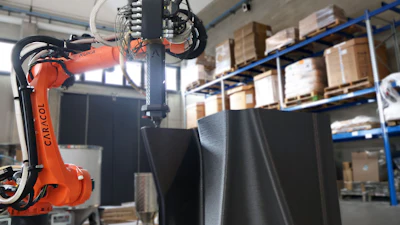
Caracol recently employed its Heron AM robotic large-format additive manufacturing (LFAM) platform, equipped with a high flow extruder, to produce carbon fiber-reinforced polycarbonate molds. Duqueine uses the molds to laminate the carbon fiber engine cover on its D09, a Le Mans Prototype 3 (LMP3) vehicle designed and assembled in France. Equipped with a Toyota twin-turbo V6 engine, the D09 was in development for some 18 months to race in the entry-level endurance racing class.
 This cure tool was 3d-printed in 16 hours.Caracol
By integrating Caracol’s robotic AM technology, Duqueine has enhanced its production model, ensuring reliability close to the point of use. With three delivery centers strategically located across championship venues, the company enables Duqueine cars to be tested and optimized directly on the track alongside its engineering team. This agile, sustainable model improves training efficiency and accelerates performance tuning.
With Heron AM, Duqueine now produces high-quality autoclave molds, cure tools, and fixtures with unmatched design flexibility, reduced lead times, and improved cost efficiency for its LMP3 championship.
“Caracol supported us from the design phase through to manufacturing, helping to define the optimal printing strategy. The Eidos Builder software also evolved to adapt to our parts’ characteristics and production needs,” says Florent Noel, R&D Director of Duqueine Group. “With this technology, we have significantly reduced manufacturing lead time and, in just six months, produced 60 molds and masters.”
Technical & Performance Data:
- AM platform: Heron 400, with High Flow extruder
- Nozzle size: 12 mm
- Material: Polycarbonate reinforced with 20% carbon fiber
- Printing time: 16 hours
- Size and Weight: 1000 x 2300 x 2400 mm, 300 kg (~660 lbs)
- Post-processing: CNC
- Weight reduction: 20%
- Waste reduction: up to 50%
- Lead time reduction: up to 50%
 Duqueine Automotive and Caracol AM recently partnered on a project that could reshape how cure tools are made for composite componentsCaracol