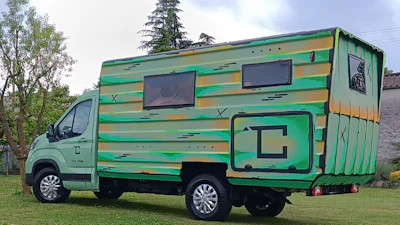
LG Project Management, a Swiss company focused on innovative mobility solutions, recently collaborated with Caracol AM to develop The Cab, the world’s first functional, fully 3D-printed mobile living module. The project was printed as a single piece on Heron AM, Caracol's robotic large-format additive manufacturing platform.
Large-format additive manufacturing (LFAM) is a paradigm shift offering design freedom, efficient material use, and the ability to integrate recycled feedstocks into high-performance products. This project was a milestone, producing a monocoque RV with a fully digital design-to-print workflow.
Beyond the technology, achieving successful real-world applications requires a deep understanding of the entire workflow — from design to materials to production and post-processing — to ensure industrial scalability and compliance.
Manufacturing parameters and benefits
The project was developed with a long-term vision, analyzing each step of the workflow to establish the foundation for future industrialization. The choice of a recycled PET-based polymer reinforced with glass fiber and UV-resistant properties ensured the mechanical, thermal, and fire-retardant performance required for outdoor and mobile applications.
By printing the monocoque in a single, uninterrupted process, the need for traditional fiberglass molds, adhesives, and multi-component assemblies was eliminated. The approach not only improved structural integrity and watertightness but also reduced environmental impact, achieving a 60% reduction in material waste.
 The Cab was printed as a single piece on Heron AM, Caracol's robotic large-format additive manufacturing platform.Caracol AM
The process enabled the production of a single-piece monocoque, completely avoiding assemblies, with waste reduction of around 60% compared to fiberglass lamination methods and a significant lead-time reduction — just one week with LFAM versus approximately three months with traditional production.
Key facts
- System: Heron 400 HF rail
- Nozzle size: 8 mm
- Material: rPETG GF UV resistant
- Printing time: 92 h
- Weight: 660 kg
- Dimensions: 4300 × 2100 × 2100 mm
- Post-Processing: sanding and painting
Innovation in design and production
The digital workflow on the Heron AM platform allowed engineers to integrate cavities and channels directly within the printed RV, simplifying the installation of electrical, plumbing, and heating systems. The feature reduces both production time and potential points of failure compared to traditional RV structures.
Weighing 660 kg, the monocoque ensures mobility efficiency while maintaining robustness against mechanical stress and vibration. Its design supports multiple configurations — from camper to mobile office, tiny home, or floating living unit — highlighting LFAM's flexibility and scalability in creating tailored solutions for different lifestyles and markets.
The Cab is a tangible example of how additive manufacturing can accelerate innovation in the RV and mobile living industry. The project demonstrates the feasibility of building highly customizable, sustainable, and road-ready living modules in a fraction of the time required by traditional methods.
This could be the beginning of a new era for mobile living solutions — one where technology, sustainability, and design freedom converge to redefine how people create and experience their personal spaces.