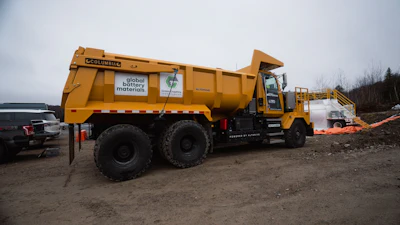
Global Battery Materials (GBM) announced the launch of a battery-electric vehicle (BEV) haul truck test study at its Kearney Graphite Mine in Ontario. The study, led by MEDATech Engineering, supported by Green Graphite Technologies (GGT) and funded by Natural Resources Canada's Energy Innovation Program, pairs digital modeling with a weeklong real-world trial of MEDATech's vocational haul truck, which has a payload capacity of 22 metric tons.
The trial runs MEDATech's BEV truck through real-world haulage duty cycles at Kearney. Field data from the site will be used to correlate and validate the study's digital models, providing Canadian producers with a proven, data-backed path to evaluate fleet electrification before committing capital.
"Kearney is becoming a proving ground for how critical minerals will be mined in North America," GBM CEO Eric Miller said. "Demand for our graphite already exceeds this mine's production capacity and we're working toward a full restart by 2028, if not sooner. This trial lets us test electrification before we invest, so the operation we bring back is cleaner, smarter and ready for the battery supply chain from day one."
Key elements of the ongoing study:
- Digital modeling + field validation: simulated haulage performance is tested against real-world trial data from the Kearney mine site
- Ready-now technology: MEDATech's vocational haul truck can carry a 22-ton payload and is available for demonstration deployments across Canada, with MEDATech field engineering support on site
- Government backing: Natural Resources Canada is funding the feasibility study, with the Ontario Ministry of Energy and Mines serving as regulator
The study supports a vertically integrated model for Ontario battery materials: graphite mined at Kearney, processed with GGT technology and transported via electrified haulage.
"This trial is an opportunity to put our battery-electric haul truck to work in a mining environment and demonstrate what electrification can offer," MEDATech Engineering President and CEO Rob Rennie said. "By combining operating data from Kearney with digital modelling, we can better understand how truck configuration, battery capacity and charging requirements align with the mine's production needs. Battery-electric and hybrid technologies have an important role in the future of mining and studies like this help companies make informed decisions about where and how to apply them."
The BEV study is part of the restart plan. Validated haulage data will inform GBM's fleet decisions, operating costs and emissions profile as Kearney returns to production as a domestic source of battery-grade graphite for North American supply chains.
Following the trial, MEDATech will publish a case study outlining the truck's performance, energy consumption and charging requirements under Kearney's operating conditions. The case study will combine findings from the on-site trial with digital modelling to assess how battery-electric haulage could support the mine's production needs and inform future fleet and infrastructure decisions.
The partners also plan to co-present the results at a CIM-sponsored webinar in April 2027, sharing practical findings and considerations for other mining operations evaluating electrification.