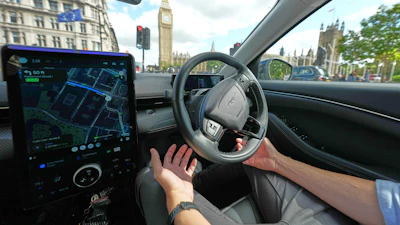
LONDON (AP) — Uber and British tech company Wayve are launching London's first self-driving taxi service on Thursday, giving residents a chance to use technology that's already available in many U.S. cities and other parts of the world.
The two companies said they're starting with a small rollout of Ford Mustang Mach-E electric vehicles outfitted with Wayve's autonomous vehicle technology.
Compared with the U.S. and China — countries where robotaxis operate autonomously in several cities, with no human driver — Europe has been taking a more cautious approach on self-driving cabs.
In London, there will still be a person behind the wheel overseeing the trip who can grab the wheel or tap the brakes if there's a problem.
Under the U.K. government's pilot framework, self-driving taxi operators like Uber and Wayve still need approval to operate without a human safety driver. "That process is still playing out," and it's not clear how long it will take, said Sarfraz Maredia, Uber's head of autonomous mobility.
Robotaxi companies have been testing their vehicles on London streets as Britain moves to adopt national regulations. Waymo and Chinese tech company Baidu are also gearing up to offer commercial passenger service in London, which poses unique challenges to robotaxis because its narrow and famously convoluted roads are frequently congested with cars, buses, bicycles and electric rental bikes.
Pedestrians also pose a bigger challenge in London because jaywalking is not against the law.
Many countries in Europe are still in the testing phase. Uber said last month it launched its first European commercial robotaxi service in Zagreb, Croatia, in partnership with a local operator and China's Pony.ai, but human safety drivers are still required.
Meanwhile in the United States, Waymo, owned by Google parent Alphabet, now operates fully autonomous taxi service in 14 cities, while Amazon's Zoox and Tesla are catching up.
In China, Baidu, WeRide and Pony.AI operate robotaxi services in multiple cities. They've also been expanding into the Middle East in partnerships with Uber or local fleet operators in Dubai, Abu Dhabi and Saudi Arabia.
The deployment in London will start with under 20 vehicles and expand from there, Maredia said.
Uber customers won't be able to specifically request a robotaxi, but they could be matched with a Wayve vehicle when they hail a ride on the app, which they can accept or reject. Prices won't be any different from a regular Uber ride. Passengers won't be prompted to tip at the end of a robotaxi trip, the company said.