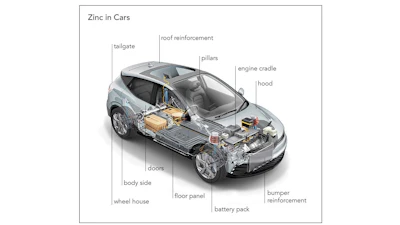
A new report from the International Zinc Association (IZA) highlighted how galvanizing cars can prevent 20% of accident fatalities in older cars. Additionally, the research from IZA’s Zinc Enables Decarbonization program found that building cars with galvanized steel—steel protected from corrosion with a zinc coating—could prevent millions of tons in carbon emissions and strengthen economic productivity in addition to saving lives.
“It only costs about $100 to galvanize a car,” International Zinc Association Executive Director Andrew Green said. “But that small investment in corrosion protection yields immense returns in a car’s sustainability, service life and safety.”
According to the report, ungalvanized cars corrode significantly after year seven, leading to 20% higher traffic fatalities, according to studies conducted independently by an Indian research institute and European consumer advocacy group.
“Our findings make a compelling case for insurers and government safety standards to require galvanization globally, especially in China and India, where only 50% and 25% of cars are galvanized respectively, versus the 95% galvanization rate in the United States, Europe, Japan and South Korea,” Green said. “Thousands of lives could be saved with this simple, cost-effective change.”
Galvanizing cars also offers a compelling environmental advantage and provided the impetus for the Zinc Enables Decarbonization research, which has been quantified and substantiated by Environmental Economist Benjamin Cox. Galvanized vehicles offer longer service lives, reducing manufacturing emissions caused by material production, component fabrication and final assembly. A galvanized national fleet would prevent, on average, five million metric tons of carbon dioxide emissions annually.
“By extending a car’s service life, galvanizing prevents the carbon emissions associated with a shorter manufacturing cycle,” Zinc Enables Decarbonization Director Eric Van Genderen said. “Zinc’s value is especially evident in electric vehicles, which if protected from corrosion, can remain road-safe for more than one million kilometers.”
In addition to safety and environmental benefits, a galvanized car reportedly yields significant economic advantages by providing additional value to the original owner, or if sold, expanding the supply of reliable and affordable used cars.
“Protecting cars from corrosion through galvanizing just makes sense and produces both immediate and long term benefits,” Van Genderen said. “With the advantages of longer service life, sustainability and safety, building with zinc is a wise and potentially life-saving choice.”