A Daimler Truck survey reported that more than 40% of fleet decision-makers consider electric trucks the more cost-effective alternative to diesel trucks from a total cost of ownership (TCO) perspective. According to 16%, both technologies are roughly on par. Around 25% of respondents see a cost advantage for diesel trucks.
Nearly a quarter of the surveyed fleet operators are already using battery-electric trucks. At the same time, the survey highlighted that further market ramp-up strongly depends on the expansion of charging infrastructure. Accordingly, market penetration remains at a low level: In 2025, heavy-duty battery-electric trucks accounted for only 2% of new registrations in Europe.
Daimler Truck conducted the non-representative survey among around 200 fleet decision-makers in Germany, France and the United Kingdom, three of Europe’s largest truck markets, focusing on different drive technologies.
Electricity Costs Considered Rather Predictable – Charging Infrastructure Significantly Less
Around two-thirds of respondents rated electricity costs as at least as predictable as diesel costs. However, when it comes to the predictability of electricity access, meaning the availability of charging infrastructure, 61%, saw electric mobility at a disadvantage.
“We Need Economic and Regulatory Framework Conditions as Well as Reliable Expansion of Energy and Charging Infrastructure”
The progress already achieved in the transformation towards road freight transport with alternative drivetrains, as well as the path ahead, was discussed by Achim Puchert and Stefan Hohm, Chief Development Officer and Member of the Executive Board of Dachser, one of Europe’s leading logistics providers, during the first edition of Daimler Truck’s new dialogue format “Customer Pulse” at IAA Transportation 2026.
Dachser has been investing in the decarbonization of its transport operations for many years. According to the company, it now operates 25 emission-free delivery areas across Europe and deploys more than 200 battery-electric trucks in both regional and long-haul transportation.
“We gain valuable real-world experience every day with our battery-electric trucks,” Hohm said. “The technology works. The next challenge is to identify the right use cases and scale the transformation across the industry. In addition to the necessary economic and regulatory framework conditions, such as toll exemptions, our transport partners need investment certainty as well as a reliable expansion of energy and charging infrastructure.”
With regard to charging infrastructure, Hohm emphasized the need for a combination of depot charging, meaning charging at company facilities, semi-public charging solutions – publicly accessible charging points on private property – and public charging infrastructure.
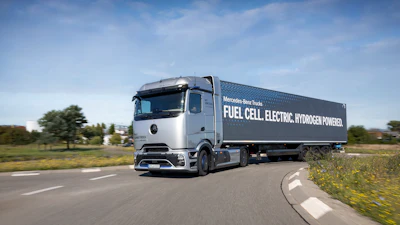
Dachser is also driving transformation beyond battery-electric technology. The logistics provider will become the first customer for the Mercedes-Benz NextGenH2 Truck. Beginning at the end of 2026, an initial liquid-hydrogen fuel-cell semi-truck is scheduled to enter daily operation, with two additional identical vehicles to follow by mid-2027.