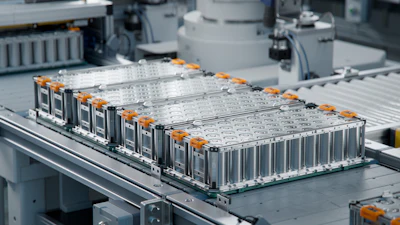
Battery packs are among the heaviest components in an EV, accounting for roughly 25% to 40% of total vehicle weight. That makes the enclosure an obvious target for manufacturers looking to cut weight without compromising battery capacity. A conventional empty metallic enclosure can add approximately 110–160 kilograms, while a composite battery case can save up to 40% in weight compared with aluminum or steel.
That weight advantage is already translating into a sizeable market opportunity. Stratview Research estimates that composite EV battery enclosures could become a $5 billion global market by 2030, growing at more than 20% annually between 2023 and 2030.
 Stratview Research
At that pace, the question is no longer simply whether composites can replace metal EV enclosures, but which composite materials, architectures and manufacturing processes can deliver the required performance at automotive production volumes.
Lightweighting is Only the Starting Point
Beyond weight reduction, molded composites provide an opportunity to consolidate multiple components and functions within the battery enclosure itself. Structural ribs, mounting points, insulating features and other functional geometries can be incorporated during molding, reducing the need for separately manufactured brackets, reinforcements and associated hardware. A lower part count also means fewer welds, fasteners and secondary joining operations, which can simplify enclosure assembly and reduce manufacturing time and complexity.
Teijin’s enclosure with a one-piece composite cover and one-piece composite tray, is one such example. It is supplemented by aluminum/steel reinforcements. Instead of assembling numerous pieces through welding, fastening and sealing, the cover and tray are molded as single pieces. Teijin specifically says this reduces the need for multiple welds, fasteners and bolts, while making the enclosure easier to seal. This also helped in making the enclosure 15% lighter than a steel battery box, while the one-piece tray eliminated through-holes and therefore the need for sealing/sealant.
Composites also allow greater design freedom, integrated features and complex geometries that gives more usable space within the same pack envelope; potentially higher volumetric energy density. Now this has a direct manufacturing implication: engineers can begin treating the enclosure as a multifunctional structure.
Apart from weight reduction, composites offer another important advantage in EV battery enclosures: lower thermal conductivity than aluminum. The thermal conductivity of carbon-fiber-reinforced composites can be 200 times lower than that of aluminum alloy, providing greater thermal insulation. This reduces heat transfer through the enclosure, helping isolate the battery pack from external heat and supporting thermal-event containment.
What It Takes to Build Composite Enclosures at Scale
For composite EV battery enclosures, the challenge is not just choosing the right material, but making it work at large scale. The industry is still betting heavily on glass fiber (GF), which accounts for >90% of the composite EV battery enclosure market, according to Stratview Research. GF offers the required strength, stiffness and thermal performance at a relatively low cost. Developers including IDI Composites International, Continental Structural Plastics (CSP) and SABIC also use GF in composite enclosure applications.
 Stratview Research
Carbon fiber (CF) on the other hand, can deliver greater weight savings and structural performance, but its higher cost limits its use in high-volume EV programs unless added performance justifies it. Its use therefore remains selective, with applications seen in models such as the BMW i3, Chevrolet Spark, Nio and BMW i3.
Composite parts are manufactured using processes such as resin transfer molding (RTM), injection molding and compression molding etc., each suited to different product and production requirements. For EV battery enclosures, compression molding is widely preferred as it requires less labor and can produce large, complex, integrated parts in fewer steps, reducing assembly needs, cost and material waste.
Compression molding of sheet molding compound (SMC) accounts for >90% of demand. Stratview Research estimates that nearly 40 million composite EV battery enclosures will be produced using this process between 2023 and 2030.
Magna, for example, uses SMC to produce large one-piece battery covers through compression molding and has reported up to 30% lower tooling investment. Teijin Automotive Technologies, Gestamp, Hanwha Group and STS Group AG are among the other companies using compression molding for composite EV battery enclosures.
The Advantages Come with a Price Tag
The economics remain one of the biggest hurdles for composite EV battery enclosures. Aluminum still has a strong hold on EV production because its cost, established supply chain and high-volume forming processes are difficult to beat.
Composites, meanwhile, can carry a significant upfront premium. Current industry estimates put standard composite battery boxes at 14% more expensive than their metallic counterparts, increasing the overall cost of electric vehicles and potentially making them less affordable.
A lighter enclosure must deliver enough value elsewhere – through part consolidation, corrosion resistance, thermal protection, lower assembly content or longer service life – to justify what it costs to make. Until that equation works at scale, aluminum will remain a formidable competitor.
The EV Boom Could Be Composites’ Next Big Opportunity
By 2025 end, roughly 1 in 20 cars already on the road globally were electrified. Under today's stated policy settings, the International Energy Agency projects that electric cars will surpass 40% of global car sales by 2030, meaning more than two out of every five new cars sold worldwide will be electric. The manufacturing trend as per Stratview Research shows that by 2030, there will be nearly 70 million EV units (light and medium-heavy commercial) manufactured globally. Observing the rising trend of EVs worldwide, the demand for enclosures set to grow significantly.
For EV battery enclosures, Stratview Research estimates the total market to be worth over $18 billion by 2030. Composites of course are set to capture a growing share of this expanding market, crossing >25% of total EV battery enclosures’ market share in the same year.
As EV platforms move toward higher energy density, greater structural integration, faster production cycles and stronger circularity requirements, the battery enclosure will become one of the clearest proving grounds for advanced composite manufacturing.
Despite all roadblocks, composites will not win simply because they are lighter. They can gain ground when the enclosure delivers several functions simultaneously – weight reduction, thermal/fire protection, quick manufacturing benefits, corrosion resistance and part consolidation – so the OEM evaluates its value at the system level rather than its material price alone.
Chandana Patnaik is a senior content strategist at Stratview Research, with experience writing about automotive trends, information technology and specialty chemicals.