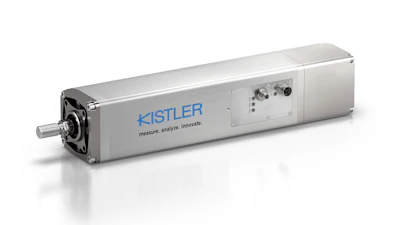
The new Integrated Joining System (IJSys) with force-displacement measurement from Kistler combines all the components of a servo press in a single housing—process monitoring and control must be connected separately via the maXYmos NC system. The company says this new joining system is an energy-saving alternative to pneumatic systems.
Electromechanical joining systems are precise, flexible, and energy-saving, yet external components such as the drive, safety or measurement technology need to be positioned in a separate control cabinet, which increases the integration effort. Kistler developed the IJSys in response to the need for a space-saving and easy-to-integrate solution.
 The Integrated Joining System is easily connected to industrial machinery and plants using two plug-in cables: a hybrid Y-cable for power and logic supply as well as data transmission, and another cable for safety technology.Kistler Group
The new joining module combines all components in one unit. It integrates the servo drive, a precise force sensor, data digitization and the safety technology directly into the module.
The system digitizes the force-displacement data internally and transmits it via an EtherCAT interface. Users can evaluate the data with the company's maXYmos NC process monitoring system. The data can also be processed directly in a higher-level system.
During the development of the new servo press, Kistler reduced space requirements and integration effort by minimizing the number of cables. The system supplies power, logic and data transmission via a single hybrid cable. Only the integrated safety technology requires an additional cable to connect the module to an emergency stop system, for example.
 Precise force-displacement control for stable joining processes is based on the parameters of force, position, and speed, as well as clearly defined limit values and reproducible process windows. The process data force and displacement are recorded in real time so that deviations can be responded to.Kistler Group
Additional features include:
- A power supply designed for 48 volts instead of the usual 230 volts or 400 volts—eliminates the need for a licensed electrician to connect the system.
- A joining force of up to 2.5 kN.
- A stroke of 200 millimeters.
- A travel speed of 250 millimeters.
- A mechanical interface designed in accordance with ISO standard 15552.
According to the company, its particularly suitable for applications in electronics and automotive manufacturing, where pneumatic systems have previously been used primarily due to space constraints or cost reasons.
For more information, visit kistler.com/C00000885.