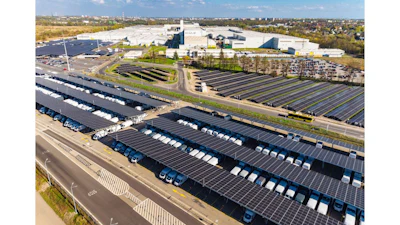
Stellantis announced an accelerated rollout of renewable energy generation and storage solutions across its European manufacturing network. The automaker's European manufacturing sites now source 68% of their electricity from decarbonized energy.
The company expects on-site self-consumption to account for 31% of energy used across its European plants in 2026, with leading sites targeting as much as 80%.
Photovoltaic Projects
Stellantis is scaling up on‑site photovoltaic projects across Europe through partnerships with energy providers, primarily under the on‑site Power Purchase Agreement (PPA) model. Under this model, energy partners manage the full lifecycle of the photovoltaic installations in line with the specific energy needs of each plant, with ownership ultimately transferred to Stellantis at the end of the agreed term.
So far, photovoltaic projects have been completed or are underway at 27 European manufacturing sites, representing more than 500 MW of installed capacity. At sites such as Tychy (Poland), self-consumption could reach around 60% by the end of 2026. In Zaragoza (Spain), where a hybrid system combining photovoltaic power and on-site wind turbines is already operating, self-consumption could rise to as much as 80%.
Depending on site configuration, the photovoltaic systems are installed on rooftops, parking canopies or ground‑mounted areas. Once fully operational, they are expected to result in more than 100,000 tons of avoided CO₂ emissions per year.
Deploying Battery Energy Storage Systems
In parallel with photovoltaic deployment, Stellantis is rolling out battery energy storage systems (BESS) to further optimize energy usage and support grid stability across its manufacturing sites.
The BESS program will cover 20 manufacturing sites across Europe, with a total installed storage capacity of approximately 200 MWh, rolled out in two phases. The first wave is already at an advanced stage, with BESS expected to be operational at seven plants by 2026, while deployment across the remaining sites is planned to be completed within a three‑year timeframe.
These systems are managed by advanced energy management systems (EMS) that optimize battery operation based on energy availability and demand. At plants equipped with photovoltaic generation, the storage systems also maximize solar self‑consumption by storing surplus energy.
In addition, the installations can provide grid services in collaboration with local system operators, helping support grid stability by adjusting consumption when needed. The Stellantis Madrid site in Spain already operates a battery energy storage system and serves as the pilot plant for scaling and standardizing this solution.
Diversifying the Energy Mix
These initiatives complement other energy contracts and decarbonization actions already launched by Stellantis across its global operations.
Additionally, Stellantis is expanding the use of geothermal energy as a low‑carbon solution for industrial heating and cooling. The geothermal installation at the Caen site in France, inaugurated last year, is a world‑first for Stellantis and supplies renewable heat to buildings and cooling for industrial processes, enabling the site to cover around 30% of its energy needs autonomously.
Several manufacturing sites are also deploying biomass‑based energy solutions to decarbonize industrial heating. These include Rennes (France), where a zero‑carbon heating network based on locally sourced biomass was launched in 2025, as well as Sochaux and Vesoul (France), Trnava (Slovakia) and Kragujevac (Serbia), where biomass‑based solutions have recently become operational.