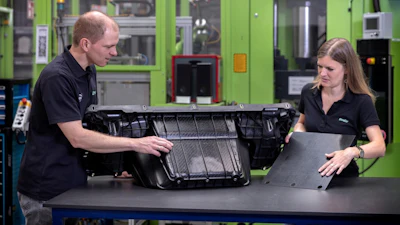
German auto parts supplier Röchling Automotive SE announced the development of a plastic frunk that doubles as storage space and a structural chassis component on a fully electric four-door sports car.
The polypropylene frunk features Tepex organosheet-reinforcements from German chemical manufacturer Envalior in its rear wall and the bolted floor sections. The thermoplastic composite material contains fabrics with multiaxially oriented continuous glass fibers, giving the structural part the strength required to withstand the high loads encountered in extreme driving scenarios, such as sudden lane changes, crosswinds or racetrack use.
In this design, the frunk connects a strut brace to the front-axle carrier and stiffens the front axle by acting as a vertical shear panel. As a result, the lightweight component enhances road contact and driving stability.
Envalior will showcase the frunk at Fakuma 2026.
Manufactured in a single process step
“Frunk” is a coined term derived from front and trunk. In electric vehicles, the component is in the front end, where the engine sits in combustion-engine cars, and serves as storage space.
The sports car's frunk measures approximately 1,100 mm long, 450 mm wide and 370 mm high. Röchling developed a hybrid-molding process for its production, combining thermoforming of the Tepex organosheet with injection molding in a single mold. This enables the production of a fully finished, rework-free component in a single manufacturing step.
“Beyond the frunk’s design as a highly load-bearing chassis component, the manufacturing process we developed represents another key highlight of the application,” Röchling Automotive Global Product Manager for Structural Lightweight Design Matthias Schütte said. “Achieving uniform mold filling despite the complex geometry, while simultaneously minimizing weld lines to ensure the part’s high mechanical performance, was particularly challenging.”
 This plastic frunk combines storage with a highly load-bearing chassis function in a fully electric, four-door high-performance sports car.Envalior
Fiber orientation precisely tailored to withstand tensile, bending and shear loads
The frunk is reinforced with a multilayer Tepex organosheet, featuring continuous fibers oriented at 0°/90° in the outer layers and +45°/-45° in the inner layers. This multiaxial laminate architecture is precisely tuned to the component’s direction-dependent mix of tensile, bending and shear loads.
The 0°/90° fibers primarily improve crash performance, while the ±45° fibers ensure optimal vehicle dynamics under extreme lateral loading. During highly dynamic driving maneuvers, off-road operation or high-speed cornering, lateral forces can twist the front body structure—a deformation prevented by the frunk’s high torsional stiffness. Bolted to the strut brace at the upper flange and to the front-axle carrier at the bottom, the frunk acts as a vertical shear panel.
A unique competitive edge through multiaxially reinforced organosheets
“As a producer of organosheets, we have unique expertise,” Envalior Sales & Project Manager Global Sales for Tepex Klaus Vonberg said. “We can produce customized multilayer organosheets in high-volume production with continuous fibers oriented not only at 0° and 90°, but at virtually any angle required. This allowed us to engineer a customized organosheet for the frunk whose fiber orientations follow the exact load paths within the component, making it precisely adapted to the load-specific requirements.”
A key advantage of Envalior’s multiaxially reinforced organosheets is their ability to withstand high forming degrees. The fabric layers are resistant to fiber shifting and remain intact even at component corners, ensuring a highly reproducible forming process and consistently high part quality.
Hybrid molding paves the way for frunks with highly complex inner architectures
According to Vonberg, Tepex will make it possible to manufacture future frunks with significantly greater functionality and more sophisticated geometries, while fulfilling structural tasks within the vehicle body. This is because the hybrid-molding process enables cost-efficient, high-volume integration of additional features directly into the component.
“In the future, it may be possible to integrate features such as cool boxes, drawers, cargo nets or holders for the charging cable directly into these frunks,” Vonberg said.