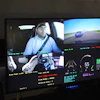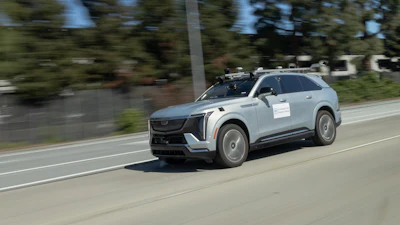
This week, GM began supervised public-road testing of its next-generation automated technology on limited-access highways across California and Michigan. The platform was trained on millions of real-world miles and stress-tested millions of times in simulated scenarios, according to GM.
If everything goes well, the tests will lead to more than 200 manual and supervised development vehicles operating in live traffic environments. However, each vehicle will have a trained test driver at the wheel who can take manual control at any time.
The announcement marks a significant transition from manual data collection to active automated technology testing on public roads.
GM data-collection vehicles have driven more than 1 million miles across 34 states. The dataset now powers the next-generation automated technology entering supervised testing. The automaker said this phase is a critical next step in GM's "disciplined, incremental approach" to bringing automated driving technology to personal vehicles at scale.
Some rivals have faced scrutiny for misrepresenting automated driving technology and rushing it to market. Last year, a judge said Tesla misled drivers by using terms like "Autopilot" and "Full Self-Driving" to describe purported semi-autonomous capabilities. Tesla has since switched to the term "supervised."
Meanwhile, the National Highway Traffic Safety Administration is investigating several Tesla crashes as the company prepares to roll out a new model with no steering wheel or pedals.
In October, GM announced plans to bring eyes-off driving to market in 2028, with the Cadillac Escalade IQ electric SUV as the debut model. Eyes-off is a self‑driving system that isn't "dependent on continuous driver vigilance for safety." After the debut, GM plans to roll out the tech to additional gas and electric vehicles. It will launch on highways first and then driveway-to-driveway, according to the company.
The technology is built on GM's new centralized computing architecture, which consolidates vehicle intelligence from dozens of distributed modules. The dataset comes from Super Cruise, which has accumulated more than 800 million customer-driven miles across 23 vehicles, and more than 5 million fully autonomous miles logged without a human driver in complex urban environments.
GM says real-world testing is essential to build a trustworthy system. Data captured during this new phase will feed directly back into the development cycle, improving the AI driving model. To complement real-world data, GM's simulation environment enables engineers to simulate roughly 100 years of human driving every single day.