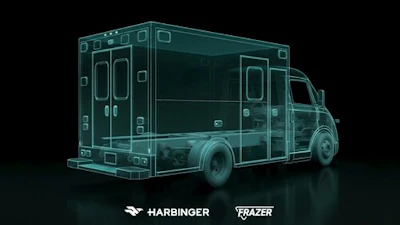
Harbinger, an American automotive and industrial manufacturer, and Frazer, a provider of mobile healthcare solutions, today announced a strategic partnership to advance the future of mobile healthcare.
Frazer will leverage Harbinger's plug-in hybrid vehicle chassis and battery technology to electrify emergency medical response vehicles and create next-generation mobile healthcare products. As part of Frazer's long-term alignment and shared commitment to the partnership, the company has also made a strategic financial investment in Harbinger. In return, Harbinger is investing time, engineering expertise, and development resources to support Frazer's expansion into next-generation electrified mobile healthcare platforms.
The Frazer and Harbinger collaboration will include multiple next-generation mobile healthcare products:
- Hybrid-electric emergency medical services (EMS) platform: An emergency medical response vehicle built on Harbinger's hybrid chassis to support mission-critical reliability, clinical grade power redundancy, and drastically reduced operational complexity.
- Hybrid-electric mobile healthcare unit: A mobile healthcare platform built on Harbinger's hybrid chassis to support care delivery outside traditional fixed location facilities, supporting community centered care models, hospital system extensions, and other emerging use cases.
- Advanced auxiliary power systems: Next-generation power storage solutions based on Harbinger's advanced battery technology, providing clean, stable, and redundant power for field medical care in both hybrid and internal combustion engine vehicles.
Fully electric vehicles have struggled to meet the complexities of emergency medical operations due in part to charging constraints, unpredictable duty cycles, and power redundancy. Hybrid systems offer a practical and immediately deployable solution. Harbinger's hybrid offering leverages its proven electric chassis, and pairs it with a gas-powered range extender that recharges the battery when needed. This architecture enables significantly reduced emissions during extended idling, stable and redundant power delivery for onboard medical equipment, and simplified energy management, without disrupting existing workflows and patient care.