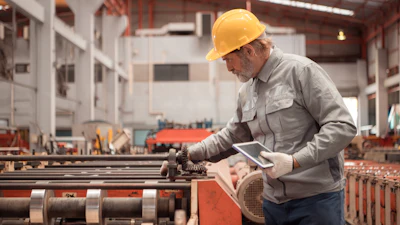
With a quarter of its workforce already 55 or older, manufacturing faces a looming dilemma: An intense wave of retirements is poised to challenge the industry’s stability.
With this “Silver Tsunami,” intense labor shortages are a huge concern, but many plants face a deeper, less visible challenge. As worker after worker leaves the factory floor, decades of knowledge will leave with them, abandoning younger employees with little guidance in a landscape that is becoming more complex and more demanding by the second.
The lack of experienced workers and their knowledge calls into question one of the most important aspects of manufacturing: machine reliability.
For years, manufacturing professionals have developed the expertise necessary to operate efficiently and maintain uptime, but with 4.1 million people turning 65 every year through 2027, a steady stream of exits will soon threaten that repository of knowledge. And when it comes to maintenance and machine reliability, the cost of losing that expertise will manifest as hours of downtime and millions of dollars lost.
This negative shift is poised to become our new reality, unless facilities intervene today.
There’s a roughly three-year window before the largest wave of experienced personnel retires, making now a critical time to capture what veteran employees know and document it in the systems you’re already using.
Technology is a huge part of building this safety net, and, in terms of machine reliability and overall facility health, that means starting with condition-based monitoring (CBM) tools to pave the way for advanced predictive maintenance strategies.
A Change in Reliability
Since the dawn of industry, maintenance has been an intuitive craft in which seasoned professionals walk the floor and use manual vibration and temperature readings to develop deep mechanical fluency in machine health. But today’s leaner, younger workforce lacks the decades required to build that level of seasoned expertise, and, frankly, has an appetite for something much more productive. Modern technology doesn’t just satisfy that desire; it also fills the labor and knowledge void left by retiring experts.
Adopting modern CBM solutions immediately gives maintenance technicians and reliability teams back precious time, eliminating the need for constant manual readings that weren’t providing the most accurate view of machine health in the first place. In an industry pressed for time and labor, that kind of efficiency is essential and there are still more benefits to consider.
Modern CBM solutions also bridge knowledge gaps by digitizing veteran expertise and transforming decades of manual observation into precise, high-value data. Before legacy experts exit the plant, applying modern CBM tools gives teams a way to codify industry knowledge into repeatable digital rules. Years of mechanical fluency won’t be lost. Instead, reliability teams can leverage that data to train the systems that will guide next and future generations. The engine behind this continuous guidance is a robust sensor network.
CBM sensors continuously monitor machine health and generate real-time data to flag when a machine’s condition starts to deteriorate, creating the groundwork for effective predictive maintenance (PdM). This powerful solution is the epitome of empowering a new generation of workers, providing enough time and guidance to help even the most junior employees understand how to mitigate potential failures.
The Power of Predictive Maintenance
While CBM has made major strides in machine reliability, it’s PdM that takes things a step further. PdM takes data from sensors and, using advanced AI and machine learning, recognizes and flags the earliest patterns of machine failure long before a maintenance technician or CBM sensors catch a spike in vibration, temperature or other metrics.
Not only does this give less experienced teams far more time to address machine anomalies before they become emergencies, but the right predictive maintenance partner can also help even the most junior employees understand what data means, which assets need to be prioritized and what their next steps should be.
Sensors and AI do a lot of the heavy lifting by spotting subtle machine changes faster than other traditional methods, but all of this data can be difficult for even experienced professionals to understand, let alone those who are industry newcomers. This idea underscores an important point: reliability teams should be prioritizing predictive maintenance partners that keep humans at the core of their work. AI and other tech is not filling labor gaps by replacing human work. It’s augmenting the power of humans to help them do more with less time and less experience.
Looking Forward
As retirements accelerate and the three-year window of opportunity begins to close, the most strategic move for any reliability team is to implement systems that capture expiring knowledge. The goal is to keep seasoned expertise accessible while providing the modern, high-tech environment that attracts a younger workforce — and that effort must start today.
Rather than erasing history, AI adapts through a continuous feedback loop that improves in accuracy as it ages. The immediate priority is making sure this learning begins with the experienced professionals who will soon trade the plant floor for retirement. While AI is often misconstrued as a replacement for human expertise, it’s actually the opposite. AI-driven predictive maintenance is exactly how we preserve the knowledge of today’s industry veterans by capturing information that will train both younger employees and AI models as the landscape evolves.  Glenn Gardner, Chief Strategy Officer, WaitesWaites
Ultimately, the next era of machine reliability — one where a large portion of today’s workforce is no longer present — will be defined by this symbiotic relationship between human and machine. Predictive maintenance won’t just keep assets running. If applied today, the solution will ensure the legacy of veteran expertise remains alive and actionable for every generation that follows.
Glenn Gardner is the chief strategy officer at Waites.