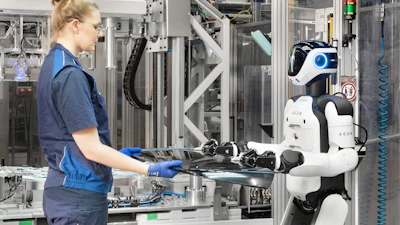
The BMW Group announced a pilot project that will deploy humanoid robots at its Leipzig plant in Germany. The development looks to integrate humanoid robotics into existing series production of cars and to explore further applications in the production of batteries and components.
“Digitalization improves the competitiveness of our production," BMW AG Member of the Board of Management Milan Nedeljković said. “The symbiosis of engineering expertise and artificial intelligence opens up entirely new possibilities in production."
 Humanoid Robotics at BMW Group Plant LeipzigBMW Group
First pilot project with humanoid robots in Europe
In collaboration with Hexagon, a long‑standing, established partner of BMW Group in the field of sensor technology and software, the first pilot project in Europe is now underway.
Hexagon’s organizational unit located in Zürich, Hexagon Robotics, specializes in Physical AI and presented its first humanoid robot, AEON, in June 2025. Following an initial theoretical evaluation phase and successful laboratory tests, an initial test deployment took place at BMW Group Plant Leipzig in December 2025. A further test deployment scheduled from April 2026 will ensure full integration for the actual pilot phase starting in summer 2026.
The deployment in Leipzig focuses on testing a multifunctional application of the robot. It is based on AEON’s design, whose human‑like body allows a wide range of hand and gripper elements or scanning tools to be flexibly attached and enables dynamic use on wheels. During testing and later in the pilot phase, the robot will help with high‑voltage battery assembly and component manufacturing.
The announcement follows the company's pilot project with humanoid robots at its Spartanburg plant in the U.S.
BMW Group reportedly uses intelligent systems in almost all production steps, including the virtual factory, digital twins, AI-enabled quality controls, intralogistics and autonomous transport solutions. The company added that its consistent and standardized data enables digital AI agents to handle increasingly challenging tasks autonomously.
“Our aim is to be a technology leader and to integrate new technologies into production at an early stage," Senior Vice President Production Network, Supply Chain Management Michael Nikolaides said. “Pilot projects help us to test and further develop the use of Physical AI—that is, AI‑enabled robots capable of learning—under real-world industrial conditions.”
BMW Group stated that its consistent data platform in production makes it an attractive partner for technology companies seeking to test the possibilities of Physical AI, particularly humanoid robotics, in an industrial environment under real-world conditions. By setting up the new “Center of Competence for Physical AI in Production,” the BMW Group wants to ensure that the full range of knowledge can be leveraged across the organization.
The company evaluates technology partners according to defined maturity, industrialization criteria and tested in pilot projects under real-world production conditions. Following a theoretical assessment, it conducts an evaluation at the manufacturer’s site in the laboratory using real use cases from the BMW production system to test integration capability. If successful, the company carries out an initial test deployment under real-world production conditions at a BMW Group plant and, subsequently, the actual pilot phase.
 Humanoid Robotics at BMW Group Plant LeipzigBMW Group
Successful pilot at BMW Group Plant Spartanburg
The world’s first deployment of humanoid robots at a BMW Group plant took place at the Spartanburg plant in the U.S. in 2025, in collaboration with the technology company Figure AI.
The results demonstrated that Physical AI can deliver added value under real-world conditions. Within 10 months, the robot Figure 02 supported the production of more than 30,000 BMW X3, working 10-hour shifts daily from Monday to Friday.
Figure 02 handled the precise removal and positioning of sheet metal parts for the welding process, a demanding task in terms of speed, accuracy and physical exhaustion. In total, it moved more than 90,000 components and covered approximately 1.2 million steps in around 1,250 operating hours.
The pilot confirmed that humanoid robots can safely perform precise, repetitive work steps, such as positioning components with millimeter precision. The initial test phases with Figure 02 involved all areas of the production IT infrastructure, occupational safety, production process management and shop floor logistics.
BMW Group discovered a faster-than-expected transition from the laboratory to the actual production environment. Motion sequences trained in the laboratory quickly transferred into stable shift operation. To ensure smooth coexistence with existing systems, integration into the BMW Smart Robotics ecosystem was implemented via standardized interfaces.