ABB Robotics announced yesterday that it is integrating NVIDIA Omniverse libraries into its RobotStudio to help manufacturers deploy physical AI in real-world robotics applications.
The collaboration focuses on combining ABB Robotics' software programming, design and simulation suite, RobotStudio, with the physically accurate simulation power of NVIDIA Omniverse libraries to close technology's long-standing 'sim-to-real’ gap.
Developers can simulate robots using digital twins and generate synthetic data to train their physical AI models, enabling businesses of all sizes and types to deploy AI-driven robotics across various industrial workflows. Called RobotStudio HyperReality, the resulting physically accurate simulations and foundation models are continuously optimized with real-world data feedback, continually improving the system. These models can be used to train any number of ABB robots, anywhere in the world, with the reliability and accuracy demanded by industry.
Closing the 'sim-to-real' gap
The long-standing deficit between simulation accuracy and real-world lighting, materials and environments is known as the ‘sim-to-real’ gap. For decades, this gap has limited manufacturers' ability to design and develop advanced manufacturing processes in the virtual world.
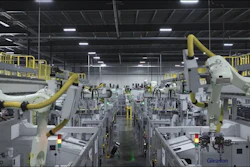
 ABB Robotics RobotStudio simulation (left) compared to new RobotStudio® HyperReality (right).ABB Robotics
By integrating NVIDIA Omniverse libraries into RobotStudio, ABB Robotics will deliver robotics simulation and synthetic data generation capabilities that will allow intelligent robots to bridge this gap with up to 99 percent accuracy.
ABB is the only robot manufacturer with a virtual controller running the same firmware as the hardware, ensuring near-perfect correlation between simulation and real-world performance. Combined with ABB Robotics’ Absolute Accuracy technology, which reduces positioning errors from 8–15 mm to around 0.5 mm, ABB delivers precision in both virtual and physical environments, making it suited to high-precision industrial-grade applications.
This innovation enables manufacturers to design, test, and optimize production lines virtually, cutting setup and commissioning times by up to 80 percent, reducing costs by up to 40 percent by eliminating the need for physical prototypes, and accelerating time-to-market for complex products such as consumer electronics by 50 percent, according to ABB.
ABB Robotics is also evaluating the potential to integrate the NVIDIA Jetson edge computing platform into its Omnicore controller to enable real-time AI inference at the edge across its extensive robot portfolio.
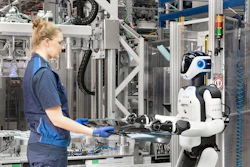
 New ABB Robotics RobotStudio® HyperReality (left) verses a real world image of the same robotic cell.ABB Robotics
Real-world applications at Foxconn and Workr
RobotStudio HyperReality will serve industrial clients at any scale, with select customers already testing its capabilities ahead of a full release in the second half of 2026.
Foxconn, the world’s largest electronics contract manufacturer, is piloting the first joint use case in consumer electronics assembly. Automating the assembly of a tiny component in consumer electronics is challenging, as multiple device variants require different production methods and the delicate metal structure requires precise pick-and-place and assembly control, along with fine-tuned setup, often requiring additional debugging time and engineering resources.
Using RobotStudio HyperReality, Foxconn’s assembly robots are trained virtually with synthetic data to perfect multiple real-world production processes across various scenarios, before moving them to the production line with 99 percent accuracy. By optimizing production lines virtually, Foxconn will reduce set-up times and costs by eliminating physical training and tests, and accelerate time-to-market for consumer electronics.
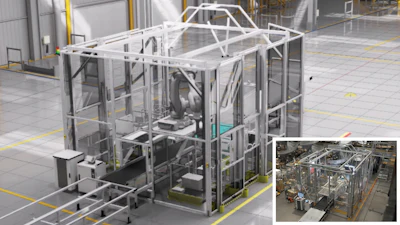
 Built on ABB Robotics' technology, California-based robotic workforce company, WORKR, trains its robots with synthetic data using NVIDIA Omniverse libraries, which are deployed without operators needing to know any programming. Real world image (bottom right) vs simulation. ABB Robotics
Workr, a California-based robotic workforce company that delivers robotic manufacturing solutions to industry, is extending the reach of this technology to small and medium manufacturers across the United States.
At NVIDIA GTC 2026 (March 16-19, San Jose, CA), Workr will demonstrate AI- powered robotic systems built on ABB technology, trained with synthetic data using NVIDIA Omniverse libraries, and deployed without operators needing to know any programming.
By combining ABB's industrial-grade robotics with its proprietary WorkrCore AI platform, the company is helping manufacturers address critical labor shortages with its robotic workforce that can learn new tasks in minutes and be operated by anyone.